What is the Bible, anyway? And why should I read it?
The B-I-B-L-E. Yes, that’s the book for me. I stand alone on the word of God, The B-I-B-L-E.
-children’s Sunday School song
A synopsis of what Christians believe about the Bible, that you might find in a church’s statement of faith is
The Bible is God’s Word to all people. It was written by human authors under the supernatural guidance of the Holy Spirit. It is the supreme source of truth for Christian beliefs and how they should live. Because it is inspired by God, it is truth without any mixture of error, and all people can connect to God through it.
That is a great summary of what Christians believe about the Bible, so let’s try to understand what the Bible is better. Unfortunately, there are many Christians who don’t understand all that much about the Bible. That’s kind of weird. I mean, we are talking about something that Christians believe is a direct communication from God. I’ve always thought it seems counterintuitive to say something like, “That is the word of the God for the whole universe, but really I’m too busy to read it.”
The first thing to know is that the Bible is made up of a bunch of small books. Originally, they were on scrolls. Books didn’t look like they do now because for most of human history, people couldn’t simply go to the local store and buy a box of paper. Also, the chapters and verses were added much later to make it easier to find stuff, but that isn’t actually part of the Bible at all.
The Bible is split up into 2 basic parts. The Old Testament is the first 39 books. The Old Testament is called that because, well, it’s Old. Scholars debate on how old exactly, but some scholars say it’s as early as the 15th century BC, and it chronicles history over thousands of years. The Old Testament is often abbreviated to just OT. Psalms is the longest, and Obadiah is the shortest. The OT is not compiled by size of book or chronology. It is mostly by literature type.
The New Testament is newer (surprise, surprise). It focuses on the life and ministry of Jesus, and then the early Church as they followed Jesus’ teachings. It is the back third-ish of your Bible. It is often abbreviated as NT. In terms of when it was written, it starts shortly after Jesus was around, and written by some of the same people who followed him around when he walked the earth, although that part requires a separate post of it’s own, but I’m trying to make things simple. The shortest book is either 2nd or 3rd John (depending on if we’re counting verses or words), and the longest is Luke.
The Bible that the Protestants use (meaning not Catholic or Orthodox)is a collection of 66 different “books” written by over 40 authors over thousands of years. I will focus here on giving information related to the Protestant version.
The Catholic Bible contains a few extra books that the Protestant Bible doesn’t have although it doesn’t affect theology that much. For a very long time there has been controversy over books that “should have” or “should not have” been included in the Bible.
Most of what you hear about that, especially these days on the internet, is not even close to true. The books of the Bible were not chosen at some mysterious religious council, or picked for some political reason. Books of the Old Testament were well-established a very long time before the New Testament was written, and we know about the books of the New Testament being more debated, mostly because they are newer.[1] Also, it was popular for a while to write biblical-style literature more as a style of writing than trying to trick anyone into thinking it was a real account. Unfortunately, many modern people get tricked.
There were groups that did not have all of the books of the Old Testament that the Jews used. For instance, the Samaritans (which Jesus talks about and encounters in the pages of the New Testament) did not include the Prophets (books like Isaiah or Zephaniah). They mostly just used the first 5 books of the Bible, called the Pentateuch.
The books of the New Testament were picked because of the following reasons:
- Trusted Writers – The New Testament was written by mostly people that Jesus specifically picked as “Apostles.” They had authority to lead the Church. In some cases, books were written by those close to the Apostles, kind of like scribes. Whichever the case, these were people who could be trusted, and their works were authenticated as actually coming from those authors.
Unfortunately, it was been a common literary style to write in the voice of another eyewitness to the events of Jesus or the early church throughout history.[2] Those authors weren’t sometimes even necessarily pretending to fake an account, but write from their imagination of what the character may have thought. It was only later that some people would claim the writer’s authenticity. - Agreement with the rest of the Bible – Different than a religion such as Islam, Christians believe that God is remarkably consistent. Therefore, the words of the Bible should agree. In the Bible, something God says is evil in one book, can’t be supported in another book.
There are people throughout history who have claimed contradictions in the Bible. I often laugh when some random guy on the internet claims to have found contradictions that no one in 2,000 years has ever noticed. Despite some guy with a handle like @DaveSmith32 who thinks he’s smarter than anyone for over 2,000 years, the Bible is remarkably consistent. - Wide acceptance – In order for books to be found as legitimate there had to already be a history of the Church accepting these books as acceptable.
Finally, in Christian circles when someone quotes a Bible verse, the citation you might see goes like this.
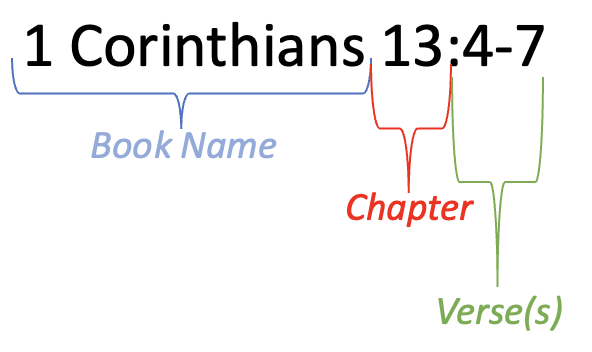
There are several books with a number in front of them, which in most Christian circles is spoken as “2nd Corinthians. This is actually a great passage to memorize. Maybe it will become the first passage that you ever memorize.
[1] Although, 2,000 years isn’t really “new” either.
[2] Heck, even the current author Dan Brown did that not long ago.